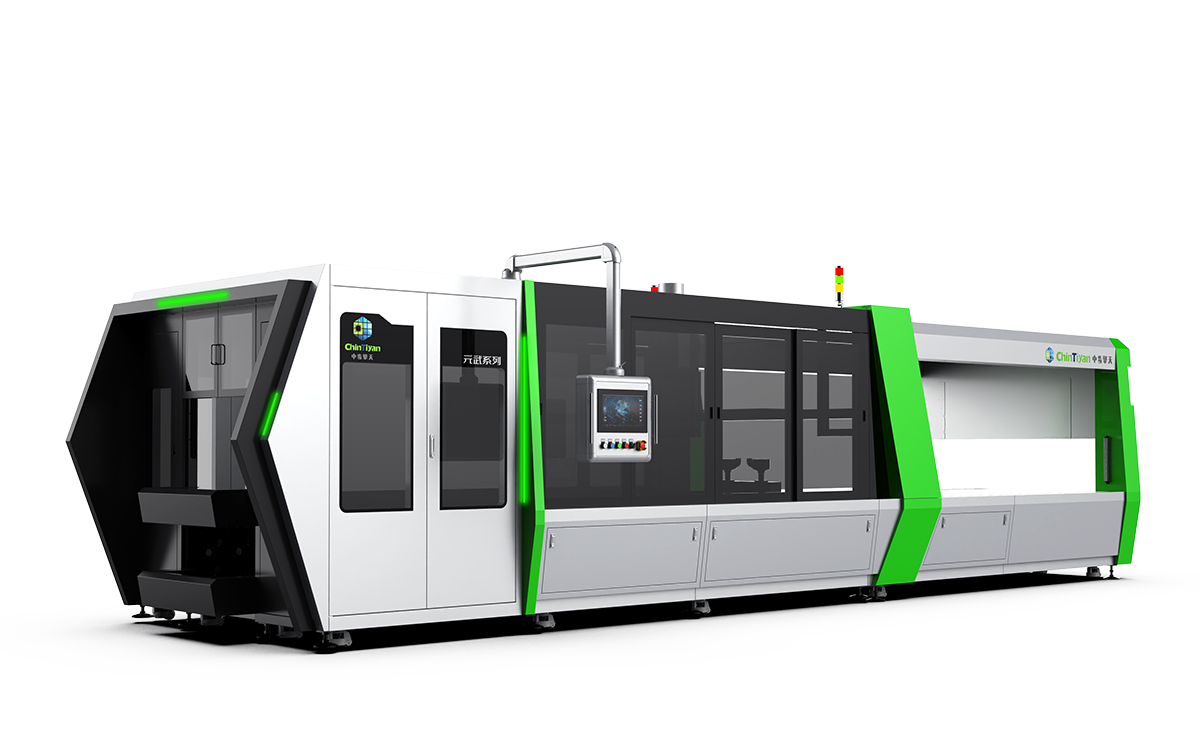
High-Speed Scribing Machine
High-Capacity, High-Speed Scribing for Large-Scale Mass Production. The CTC-80S designed for efficient photovoltaic cell processing. It delivers a capacity of up to 6,800 half-cells per hour with a scribing speed of up to 500 mm/s and a split rate as low as 0.05%.
Contact:
Details Introduction
The CTC80S is a high-speed, non-destructive scribing machine designed for the mass production of crystalline silicon solar cells, with high throughput and high stability as its core design objectives. Integrating automation technologies—including PLCs, sensors, servo systems, lasers, and CCD vision systems—the equipment executes a fully automated workflow covering loading, scribing, non-destructive breaking, separation, inspection, and unloading.
Utilizing a non-destructive scribing process, the machine causes minimal surface damage to the cells and generates virtually no dust during operation, eliminating fire hazards. As no mechanical breaking is required, the process leaves no micro-cracks, resulting in excellent mechanical integrity.
It is suitable for large-scale module manufacturing facilities and high-efficiency cell production lines aiming to maximize single-line capacity.
Parameter
Equipment Parameters
| Model | CTC80S High-speed Non-destructive Scribing Machine |
| Cell Size | 166 x166~230x230mm. |
| Thickness 120~220µm | |
| Uptime Rate | ≥ 98% |
| Production Capacity | Duplexing ≥ 6800pcs/h |
| Split Rate | ≤0.05% |
| Scribing Speed | ≤500mm/s |
| Average Laser Power | 50 W/300-500W |
| Laser Life/Warranty | Warranty 20000 hours |
| Detection | CCD |
| Feeder Detection | Positioning and defect detection (chipping, chipping, cracking, 90° flip, dirt, scratches, etc.) |
| Comprehensive Positioning Accuracy | Positioning Deviation: ≤±0.1mm |
| Angular Deviation: ≤±0.04° | |
| Unloading Detection | Detection of cracks, chipped edges and corners, large and small pieces, etc. |
| Power Supply | Three-phase 380V, 50Hz |
| Three-phase five-wire system (L1/L2/L3/N/PE), into the line specification 4x16mm² + 1x10mm² | |
| Wattage | Average power 30kW, peak power 45kW |
| Laser Chiller | Cooling water: 20 L; pure water, regular replacement |
| Lobe Cooling System Water | Deionized water, or purified water |
| Air Source | Pressure 0.6-0.8Mpa; Air consumption: ≥1200L/min; air inlet main pipe using two φ16mm hose at the same time into the air |
| Compressed air quality requirements: | |
| Maximum solid particles: 15μm (Grade 3); minimum pressure dew point: +3℃ (Grade 4); maximum oil mist concentration: 5mg/m3 (Grade 4) | |
| Air Exhaust System | Top exhaust pipe diameter Φ102mm, pipe diameter required 104mm; comprehensive exhaust flow rate is more than 600m³/h; |
| Exhaust gas temperature is high, exhaust pipe is recommended to use PVC pipe | |
| PLC | Peifu Compact Industrial PC |
| HMI | Easy Control World's upper computer software includes parameter setting, troubleshooting, alarming, product statistics, status records, and so on. |
| MES Interface | Ethernet port is reserved to support TCP/Ip and Peifu ADS protocol. |
Keyword:
High-Speed Scribing Machine
Related Products




What is the Solar Panel Manufacturing Process?
Cells are loaded by an automatic loader. For half‑cut or third‑cut, cells go through a laser scribing machine for precise splitting. The cells are then fed into a stringer, where ribbons are soldered to form cell strings. After stringing, a bussing machine interconnects the strings, followed by layup, lamination, framing, junction box attachment, and final testing (EL and flash test). The stringer machine and laser scribing machine are the most critical pieces, they determine breakage rate and soldering quality.
How to Calculate Annual Energy Production From Solar Panels?
Simply multiply the total panel power (in kW) by the annual peak sun hours in your location, then apply a system efficiency factor, typically around 80%, to get a rough estimate. But from a manufacturing equipment perspective, what matters just as much is ensuring that processes like stringing and lamination don’t introduce micro‑cracks or poor soldering, because those issues will directly reduce the panel’s actual output.
Is BC technology the Future?
BC (Back Contact) technology is undoubtedly a key direction for next-generation high-efficiency PV modules. Its busbar-free front side offers not only superior aesthetics but also significantly reduces shading, leading to higher light absorption and increased power output. Rather than simply declaring BC as the only future,In fact, BC is a platform technology that can be combined with techniques such as Topcon HJT and perovskite tandem cells to squeeze out the last drop of efficiency gains.
Therefore, we believe BC technology will remain at the forefront of the upcoming technological transformation, making now the opportune moment to invest in BC.
How to Choose the Right Stringer Machine?
First, compatibility: it must handle 182mm and 210mm cells with quick changeover. Second, breakage rate and soldering yield, test with your own cells to see real performance. Third, stability and service: the machine should run reliably for long shifts, with fast support when needed. Also check if the stringer machine can be upgraded later for half‑cut, multi‑busbar, or heterojunction processes.

Contact us
Address: 5 Xingfu Road, Miaoshan Development Zone, Jiangxia District, Wuhan City, Hubei Province, China
Scan QR Code by WhatsApp