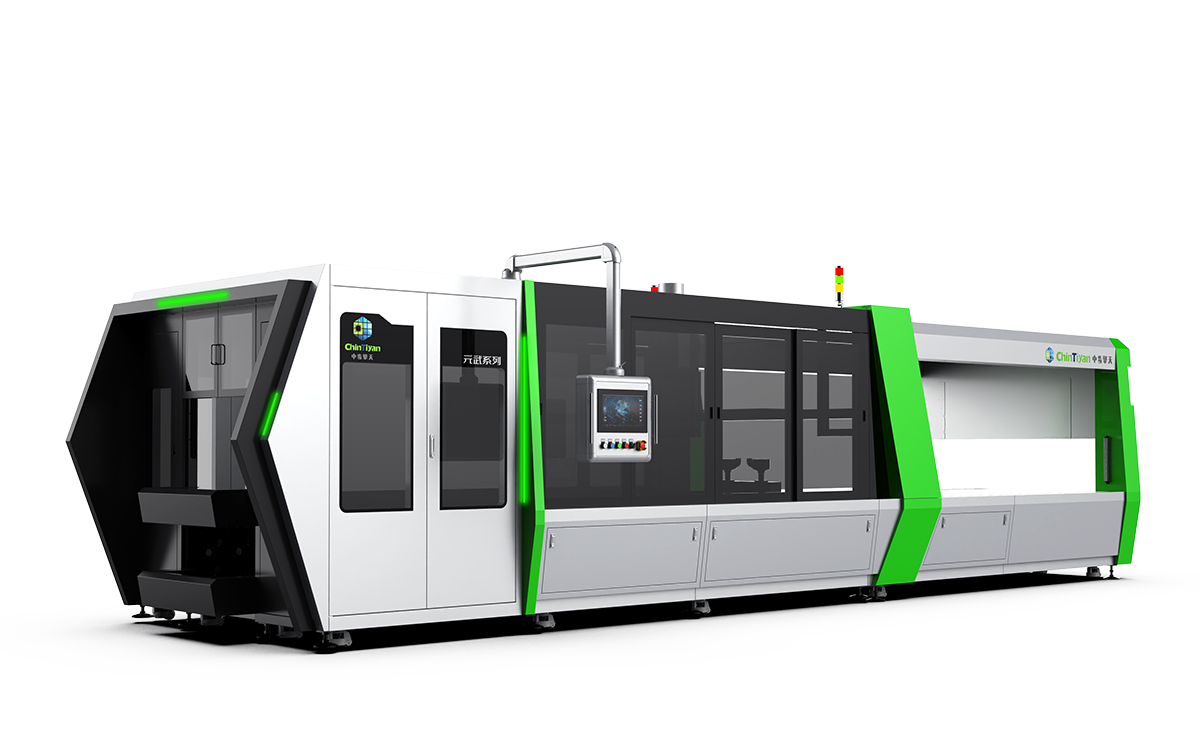
Ultra-High-Speed Scribing-Welding Machine
The CTM-S150-BC is an integrated high-speed system for precise scribing and string welding of BC solar cells. It delivers a capacity of up to 15,000 half-pieces per hour for efficient automated production.
Contact:
Details Introduction
CTM-S150-BC ultra high-speed solar scribing and welding integrated stringer machine designed for High-Precision Scribing and String Welding of BC Solar Cells. The Machine is compatible with 166mm-230mm (3BB-20BB) Solar Cells. It can produce 166mm-230mm (Half-cell) BC Solar Cell Strings. The scribing and welding integrated stringer machine adopts various advanced Automation Technologies such as PLC, Servo, Linear Motor, Thermal Cracking Laser, CCD Vision, etc., to realize the Fully Automatic Processing of Solar Cells from Feeding, Scribing, Cracking, Solar Cell String Welding, Stringing
1. Adopt High-precision industrial cameras to inspect the Solar cells
2. Realize Fully Automatic Manufacturing from Solar Cell Series Lay-up to Automatic Bussing
3. Precise Positioning, Repeat Positioning Accuracy can reach ±0.20mm
4. Adopt Dual Linear Motors to interact with X, Y, Z Axes to significantly improve the Uptime
5. Non-Destructive Scribing Technology, Causing very little damage to the surface of the Solar Cells
6. Four Sides Single Side no less than 3,600 Half-Pieces/Hour
Parameter
Equipment Parameters
| Equipment Model | CTM-S150-BC Ultra-High-Speed Scribing and Welding Integrated Stringer Machine |
| Uptime | ≥ 95% |
| Production Capacity |
15,000 Half-Pieces/Hour Four Sides No less than 3,600 Half-Pieces/Hour on one side |
| Fragmentation Rate |
Solar Cell 135µm to 150µm: Mono Crystalline ≤0.25% Soalr Cell 151µm to 230µm: Mono Crystalline ≤0.2% |
| Detection | CCD |
| Flux Method | Solder Ribbon Immersion |
| Welding Method | Infrared Welding |
| Comprehensive Positioning Accuracy | Positioning Deviation: ≤±0.05mm, Angle Deviation: ≤±0.04°, Cutting Accuracy: ≤±0.1mm |
| Dimension | 166mm~230mm Crystalline Silicon Solar Cell and Corresponding Half Solar Cell |
| Numbers of Main grid lines (Busbar) | 3BB-20BB |
| Solar Cell Pad Spacing | > 5.5mm |
| Thickness Solar Cells | 135~230±10µm |
| Maximum Solar Cell String Length | 1400mm |
| Solar Cell Positioning Accuracy | Positioning Accuracy: X, Y ≤ ± 0.1mm, Angle ≤ 0.04° |
| Solar Cell Defect Detection | Corner Chipping, Edge Collapse, Cracks, (Dark Cracks are not Required), Holes, Minimum Setting Value 0.1mm²; Grid Line Direction of Busbar (90°, 180°) |
| Piece Spacing | 一1mm~5mm |
| Accuracy of Solar Cell Spacing | Accuracy of Solar Cell Spacing: ±0.3mm |
| Soalr Cell String-out Interface: | can be connected to Automatic Robot Lay-up Machine or used independently |
| Maximum Capacity of Battery Box |
300 whole cells
String defective rate ≤3% |
| Breakage Rate | ≤15% |
| Overlap/Flip Rate | ≤15% |
| Strip Specifications | Low-temperature flat soldering strip: width: 0.6 to 3.0mm, thickness: 0.12 to 0.32mm |
| Welding Ribbon Parameters | “tin layer on one side of the average thickness: ≥ 0.018 ± 0.005mm, copper base material purity: ≥ 99.97 |
| Power supply | Three-phase 380V, 50Hz Three-phase five-wire system (L1/L2/L3/N/PE), incoming wires specification 4x70mm²+1x35mm² |
| Power Average | power 60kW, peak power 120kW |
| Water Cooling System | Pure water; average flow rate: 8L/min, pressure: 3bar, temperature: 25℃, pipe diameter: φ12mm. |
| Air source: Air pressure | 0.6-0.8Mpa, air consumption: ≥3500L/min, five φ16mm hoses are used for air intake at the same time. |
| Compressed air quality requirements |
the largest solid particles: 15μm (Class III), the lowest pressure dew point: +3 ℃ (Class IV), the maximum concentration of oil mist: 5mg/m3 (Class IV) |
| Exhaust system |
Top exhaust pipe diameter 9-Φ200mm, please connect to the factory extraction pipeline, the pipe diameter requires 202mm; The diameter of exhaust pipe is Φ65mm, connect to the factory exhaust system through the 5th Φ202mm extraction port; the comprehensive exhaust flow rate is more than 3000m³/h; the temperature of exhaust gas is high, the exhaust pipe is recommended to use PVC pipe |
| PLC | Peifu Compact Industrial PC |
| HMI | Easy Control World's upper computer software includes parameter setting, troubleshooting, alarm, product statistics, status records, etc. |
| MES Interface | Reserve Ethernet port, support TCP/Ip and Peifu ADS protocol. |
Keyword:
Ultra-High-Speed Scribing-Welding Machine
Related Products




How to Choose the Right Stringer Machine?
First, compatibility: it must handle 182mm and 210mm cells with quick changeover. Second, breakage rate and soldering yield, test with your own cells to see real performance. Third, stability and service: the machine should run reliably for long shifts, with fast support when needed. Also check if the stringer machine can be upgraded later for half‑cut, multi‑busbar, or heterojunction processes.
What is the Solar Panel Manufacturing Process?
Cells are loaded by an automatic loader. For half‑cut or third‑cut, cells go through a laser scribing machine for precise splitting. The cells are then fed into a stringer, where ribbons are soldered to form cell strings. After stringing, a bussing machine interconnects the strings, followed by layup, lamination, framing, junction box attachment, and final testing (EL and flash test). The stringer machine and laser scribing machine are the most critical pieces, they determine breakage rate and soldering quality.
How to Calculate Annual Energy Production From Solar Panels?
Simply multiply the total panel power (in kW) by the annual peak sun hours in your location, then apply a system efficiency factor, typically around 80%, to get a rough estimate. But from a manufacturing equipment perspective, what matters just as much is ensuring that processes like stringing and lamination don’t introduce micro‑cracks or poor soldering, because those issues will directly reduce the panel’s actual output.
What is Your Collaboration and After-Sales Process?
From project discussion to stable production, we provide complete technical support and long-term after-sales service to ensure a smooth and efficient cooperation experience.
1. Requirement Discussion
We communicate with you in detail to confirm product specifications, production capacity, factory conditions, and technical requirements, then provide a suitable production line solution.
2. Solution Confirmation & Contract
After confirming the technical proposal, both parties finalize the equipment configuration, layout, delivery schedule, and commercial agreement.
3. Equipment Manufacturing
While your factory prepares utilities and workshop conditions, we carry out equipment production, assembly, and internal testing.
4. Factory Acceptance Test (FAT)
Before shipment, customers can inspect and test the production line at our factory to verify equipment performance and operating conditions.
5. Shipment & Installation
The equipment is shipped to your factory, and our engineers provide on-site installation guidance and positioning support.
6. Commissioning & Site Acceptance
After installation, our engineers complete commissioning, parameter adjustment, and final testing to ensure the line operates according to agreed standards.
7. Training & Trial Production
We provide operation and maintenance training for your team and assist with trial production until stable operation is achieved.
8. Long-Term Technical Support
We provide continuous after-sales support, including remote assistance, spare parts supply, troubleshooting, technical upgrades, and maintenance support to ensure long-term stable production.

Contact us
Address: 5 Xingfu Road, Miaoshan Development Zone, Jiangxia District, Wuhan City, Hubei Province, China
Scan QR Code by WhatsApp